Showing posts with label author interviews. Show all posts

17 October 2011

Irrepressible: The Life and Times of Jessica Mitford - Review and Interview

Book Details:
Genre: biography
Pages: 344
Publisher: Counter Point, Berkeley

Confession time - before I was introduced to this book, I had no idea who Jessica Mitford was. Having read the book, I am sad I have spent so long without knowing her. What an interesting, energetic and involved character she was! Leslie Brody has done an amazing job of capturing Jessica (or Decca, as she was called). There is nothing dry or boring about either the woman or the book. This biography is well written, easy to follow and read, and interesting. There are also pictures. I happen to love pictures in biographies. My favorite is at page 214. It is a picture of Decca at age 5 looking defiant, stubborn and immovable - a foreshadowing of the woman she would become.

Leslie has generously agreed to answer a few questions about herself and the book she has written. I hope you enjoy the interview and also pick up the book. Sometimes it's good to shake things up with a bit of good non-fiction; expand your horizons and meet a wonderful, new character. Now, on to the interview!
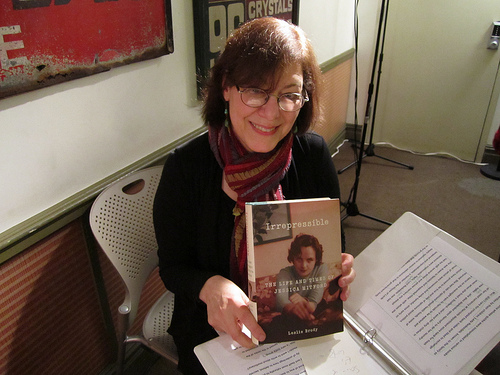

Let's start with an icebreaker. How about: what's your favorite colour and why?
Yellow: the brighter the better. I like the Yellow of Tibetan monk’s robes. Yellow just makes me happy. 

You have had a varied career in the book world as reporter, reviewer, writer, teacher, and so many more. What has been your favorite position?
Writer, everything springs from that. I’ve enjoyed my other roles, particularly as an adapter of other’s work for the stage, and I love teaching, but I’d rather be off somewhere with no responsibilities other than to the page I’m writing. I suppose I don’t really wish to have no obligations but I certainly enjoy vacations from them. I guess that’s why I like writer’s colonies which at least offer the illusion that all you need do is write.

What is it about Jessica Mitford that inspired you to want to write about her life?
She was funny and brave and a lifelong radical. She was also just really fun to be around, which I discovered is the essential element when you make the commitment to write a biography: It just really takes a long time and you need to choose someone who can live with. 

From the bibliography and notes at the end of the book, it is obvious that you did a lot of research for this project. Which was more enjoyable for you, the research or the writing?
Oh, the writing absolutely. Though I tended to complain about how hard it was, I did enjoyed a lot of the research, particularly reading great authors whom I’d never have encountered otherwise. But the organization necessary for such a big project often sent me up a wall. Mitford lived through such tumultuous times and I loved trying my hand at writing a social history.   

What do you hope readers take away from reading Jessica's story?
A sense of her courage and of how successful an investigative journalist she really was. Her work attacked the abusers of power. She was read widely and really had an effect. In the end, I think what strikes me as most important is how as both writer and activist she successfully practiced the elusive art of holding to the dreams of her youth.

Did you have the opportunity to meet Ms Mitford before her death? What was your strongest impression of her? (if yes) If you could meet her, what would you like to discuss with her? (if no)
I never met her, I wish I had.
When I first read Mitford’s memoir Hons and Rebels, I was charmed by her rebellious and funny voice, and delighted beyond measure to discover (having traveled the road she did) that she’d been a radical in her youth and remained one. I’d also left home at seventeen and set off to change the world on a utopian model. My escape was considerably less dramatic and I was fortunate to find a home in a counterculture that supported my initial wanderings and exercises in journalism. I also became passionately involved in a movement--for me the hippie arm of the new left and the movement against the war in Vietnam. I was at the time a serious young girl in an often-claustrophobic world of radicals and revolution. At times, the burden of the struggle seemed contingent on me selling enough underground newspapers for our commune to buy rice and beans for dinner.
By the early eighties, I had long since left commune life. I found work as a part-time Librarian at the same San Francisco College of Mortuary Science that Mitford had eviscerated in The American Way of Death (grateful for a job that demanded no credentials.) Four mornings a week, I would sit at a gigantic oak desk, inhaling formaldehyde and the must of unopened books, as I revised the plays I’d begun to write. I would filch announcements off the bulletin boards for week-end workshops in “head reconstruction,” and “grief counseling Bar-B-Ques,” and stash these away.  Nobody would visit my library for weeks on end, except one young mortician-in-training who desultorily flipped through some books, then finally asked me out. He thought I might enjoy a tour of the building and I did. I saw the classrooms, laboratories, embalming rooms, and in the back yard what looked like twenty plastic gasoline cans full of blood. Once as I was snooping on my own, amid the back issues of “Mortuary Management” and “Casket and Sunnyside,” I found a file folder marked Jessica Mitford. I wish I could tell you there were explosive secret documents inside but it was empty. I always thought she’d get a kick out that, but I never did write to her until I started this book, which I hope is part of an ongoing conversation about her legacy.

In the process of creating this work, was there anything you learned about 'the Life and Times of Jessica Mitford' that surprised you?
I think I was surprised by how much of her story is finally about friendship. She had a wide circle of friends, among them a group of women friends who remained close over their lifetime together. The story of these friends is one of dedication and love and heroism. They were all committed to making the world a better place and all of them risked quite a lot to put their beliefs into practice. Decca’s friends were remarkably brave women and I hope I did them justice in my book.
Another thing is just how funny she was. It’s hard to take some of her quips out of context but many of her funniest lines are associated with her work on The American way of Death. “Dissension has begun to spread in the ranks of the living.” She wrote, “Unfortunately for the undertakers, it would seem there is little popular support for the theory that a ‘fine funeral’ is America’s first line of defense and the highest expression of patriotism.” 

Do you have another book in the works? What is taking up your time now?
I am writing fiction for a change. My new book follows a family between 1923 and 1973 and roams the world with them from Russia to Amsterdam to Brooklyn to Chile. There’s still much to be done before it’s finished, but for the time being I’m calling it Is That Legal? A Novel of the Twentieth Century. I’m a full time professor these days so writing time is at a premium, but I keep plugging away.
Is there a web site or some other way readers can keep up with you? They can visit my facebook page https://www.facebook.com/home.php#!/pages/Leslie-Brody-and-IrrepressibleThe-Life-and-Times-of-Jessica-Mitford/151727748192189 and/or my website http://www.lesliebrodybooks.com/

Great answers! I want to thank Leslie for being willing to share and also for providing me with the book to review. I learned a lot and enjoyed the process. 

A Taste from page 306:
At the beginning of Christmas break, when an embarrassed dean appeared before Decca and her class (packed to the rafters) to announce that she had been "de-hired", the class erupted. Students shouted, We want Jessica! They thumped the tabletops and paraded around the lecture hall. At one point, Decca called for attention and declared, "They'll have to pick me up bodily and toss me out to keep me from teaching!"

15 October 2011

The answers to your questions and Black Purse giveaway winners

A big thanks to Stephanie for so willingly answering the questions you all submitted to enter the giveaway! The winners are posted after the interview. You all asked some great questions and Stephanie has returned some great answers. I hope you enjoy! If you haven't yet and want to read my review of the book 'Black Purse', you can find it here.

1) My question is where did you come up with the idea for the story line for this book?
While horseback trail riding in group which included a broken spirited middle aged man. He is a North Carolina Lumbee Indian who lives outside traditions while his sister and parents live very traditionally. His suffering spurred the idea years ago.

2) Do you know the ending of the book before you write it?
To a degree. End was defined in final outline as 'moment of empowerment'.

3) When you began writing for fun and then when did it turn into an occupation?
Began writing for fun with letters to doting grandparents. Then poems and short stories and then at a Christian college I wrote and distributed an unauthorized campus newsletter. Was 'claimed' and told to start up and edit an authorized paper or leave. I edited. (But unauthorized was more fun.)

4) What breed of horse is your favorite?
The pleasing, graceful and gentle Tennesee Walking Horse. They make my heart swell.

5) Ok. I suck at titles and such. It took forever to write my thesis. So any advice on how to do it?
A thesis is a battleground of analytical statements. Find your ground. Know your subject matter and write. Put it in a drawer for a month. Edit it. Put it away again. Then pull it out and read it. As soon as you are done write what you are feeling. Write one sentence that sums your thesis. From that sentence you should discover a profound title.

6) What is your favorite thing to make for supper? (the recipe would be welcome)
Sauerkraut Sandwiches! Because that means my children and grandchildren may be near. (Even with four dogs I suffer from empty nest syndrome.) When my children were small I often lied to them when they caught me eating a treat that I didn't want to share. I told them, "It's a sauerkraut sandwich," and they'd quickly leave with 'sour' expressions, when it was actually one of those expensive indulgent cookies! I do this now with my three year old grandson. But there's something about grands. I always give him one. Oh, well. My favorite sauerkraut sandwich recipe for supper follows: Heat oven to 375 degrees Combine dry ingredients: 1 cup whole wheat flour, 1/4 cup packed dark brown sugar, 1/2 teaspoon cinnamon, 1/2 teaspoon baking soda, and 1/2 cup oats. Combine moist ingredients: 1 cup crunchy natural peanut butter, 1 egg, 3 teaspoons vanilla Then combine dry and moist. Chill till stiff. Place rounded tablespoons of dough onto greased sheet. Press 3 to 4 whole salty peanuts into top of each. Bake 8 to 12 minutes. I like them slightly underbaked on top of a scoop of Bryer's vanilla ice cream. And I usually have seconds!

7) Do you read one book at a time or do you, like me, read several at a time?
Time for reading is precious so I savour one at a time and will keep it near to flip to favorite scenes to envision and relish.

8) Is your story factually correct and, if so, how did you conduct your research?
While there are many facts in ‘Black Purse’ it is centered on one major fact: North Carolina’s Lumbee Indians are recognized only by the State.
I applied the study of psychohistory to ‘Black Purse’. Psychohistory is the science of historical motivations. It studies why people do what they do. And it usually leads to a debate of what, if anything, one single individual can do to change history. And as noted from the beginning of the story, ‘The only way to change something is to bring it into the light’.
In the seven years of writing ‘Black Purse’ my chief sources for information were personal observation and online. Here are few of my sources for Lumbee research, horses, psychohistory, and sexual brokenness, listed in like sequence.
Observation
Online Encyclopedia
Lumbee Indian Websites
‘The Only Land I Know: A History of the Lumbee Indians (Iroquois & Their Neighbors) by L. Adolph Dial &David K. Eliades
‘Talking with Horses’ by Henry Blake
Years of experience
Lloyd deMause’s website on Psychohistory
Pure Passion’s website on healing sexual brokenness
Observation

9) I love to write, but whenever I start I get bombarded with so many ideas. Is it the same for you? And if so, how do you choose which idea to use?
Occasionally inspirations are clustered. Write everything down as it comes. Form it into a list. Then use the process of elimination, which is individualized for each writer. I choose the ones that make me feel something to the highest degree.

10) I was wondering if Stephanie has written other books.
Oh, yea.
https://www.createspace.com/3676064   ‘Oginalii is Cherokee for My Friend Like
Horse is to My Heart’

Young Adult Short Story
http://www.amazon.com/GRANT-ME-Thanksgiving-Tail-ebook/dp/B004A159O2/ref=sr_1_10?s=books&ie=UTF8&qid=1318259107&sr=1-10
 ‘Grant Me’

Young Adult Christian Fiction
http://www.amazon.com/Presentation-Accordance-Natural-Universal-ebook/dp/B005A5BI56/ref=sr_1_1?s=books&ie=UTF8&qid=1318259395&sr=1-1#_

‘‘Facts of Life’ in
Accordance with the Natural World’s Universal Truths’
http://www.amazon.com/Presentation-Accordance-Natural-Universal-ebook/dp/B005A5BI56/ref=sr_1_1?ie=UTF8&m=AG56TWVU5XWC2&s=books&qid=1309944180&sr=1-1
Fun Young Adult Primer
promotes environmental outlook and responsibility. Check out its sketches!


OK Winner time:


Paperback winner: Kim


e-copy winners: Alaina and singingndreamin


Congratulations to you all. Let me know what you think of the book!

23 June 2011

Interview with Bobbie Pyron author of A Dog's Way Home (Giveaway)

As promised, Bobbie Pyron has graciously answered some of the questions I had after reading 'A Dog's Way Home' (review is here). She is an amazing author and I really appreciate her taking the time to share with us!


You ran the risk of your book being overlooked as a retelling of ‘Homeward Bound’ or ‘Lassie Come Home’. Why did you decide to take the risk?

I have always said that A DOG’S WAY HOME is not only my personal love letter to dogs—specifically Shelties—but also to those great “classic” dog stories like LASSIE COME-HOME and INCREDIBLE JOURNEY that meant so much to me as a child. Those books, along with many others, were ones I read over and over as a child. I still read them! I didn’t really worry about my book being overshadowed by the two classics you mention because the style in which I tell my story is very different from those two. The duel narrations of Tam, the dog, and his girl, Abby, really set the book apart. Also, the very distinct culture of the place and people of the Appalachian Mountains sets the book apart.  I think every generation needs a “classic” dog story, and I hope mine will fill that need.

Abby’s parents are, time and time again, frustrated by her stubbornness. Do you have any personal experience with this trait?

Ha ha ha! Are you asking if I’m that stubborn?! I’m sure my husband would say that’s true, especially if I were in Abby’s situation with one of my beloved dogs. I would move heaven and earth to find them. But I think most any dog person who has that special bond with their dog would be the same way. It’s an almost mystical, spiritual bond that people have a hard time understanding unless they experience it. Abby’s parents, while very fond of Tam, didn’t have that bond with him like Abby.

‘A Dog’s Way Home’ is, ultimately, a love story. Do you have a canine love story of your own?

Oh my, I’ve had many. I am over-the-moon in love with the dogs in my life now—Boo, Teddy, and Sherlock. Boo, who is a coyote mix, is probably one of the most fascinating dogs I’ve ever been privileged to share my life with; Teddy is a rescued Sheltie that loves me possibly more than any living, breathing being ever has; Sherlock is also a rescued Sheltie and has taught me so much about resilience. And then there’s my Sheltie mix I had for sixteen years, Toola. James Herriot once wrote that every dog lover has a once-in-a-lifetime dog. Toola was mine. When I was a little kid, we had a Beagle named Puck. He was our nanny. Whenever my sister and I wanted to walk over to a friend’s house or go to the drugstore for a Coke, my mom or dad would say, “Take Puck with you and mind him.”
  
In the book, Abby’s ‘north star’ is Tam, Dad’s is music, Mom’s is Abby, as is Tam’s. How do you define North Star in this context and what is your North Star?

I think of someone’s North Star as their passion, or their bliss, that they follow. It’s that thing (or person) that makes you want to get out of bed, even on your darkest days. It gives your life direction and meaning. Certainly writing is a star in my life, a passion and bliss. But my North Star would have to be that unique relationship with my dogs (thank the stars my husband’s not overly sensitive!).

What was behind your decision to make Tam a Sheltie instead of a better known or hardier breed?

Funny you ask. When I was sending the manuscript around to editors and agents (and amassing many rejections), one agent said that she thought I was quite a talented writer and she loved the story, but couldn’t I make Tam a Golden Retriever? If I’d make that change, she might consider taking me into her fold. Ha! No offence to any readers with Goldens, but I really can’t picture them having the single-mindedness to go through what Tam did, just to be with one specific person. Shelties are known for their loyalty and the terrifically strong bond they form with their person. I always tell people, you haven’t been loved until you’ve been loved by a Sheltie.

Will there be more books of Tam and Abby’s adventures?

I’m so gratified by the number of readers who’ve asked me if there will be a sequel—that say they really want a sequel! Alas, right now there are none planned, but you never know!

I know you are involved with animal rescues. Can you tell us something about that?

Both of my Shelties came from Sheltie Rescue of Utah. I’ve volunteered with them in various capacities for the last eight years, including convincing several of my friends to adopt Shelties! I also volunteer with an organization called Friends of Animals Utah. I do everything from walking and socializing dogs to cleaning litter boxes to organizing fundraisers. Recently, I put together an event called “Authors Unleashed.” I got together with four other authors who are inspired by, and write about, dogs for a panel discussion and book signing. It was a huge success and a heck of a lot of fun!

Do you have a new novel in the works for us to look forward to?

Yes! My next book comes out Fall of 2012. The working title is MERCY’S BONE, but that title may change. It’s kind of a dog story too, and takes place in Russia in the mid 1990’s after the fall of the Soviet Union.

Where can readers find out more about you and what you are up to, professionally?

They can visit me at my website www.bobbiepyron.com. There, they can find out the latest news, read excerpts from my books (I also have a teen novel called THE RING) and see photos of my dogs. On my blog, they can read interviews I do with other authors and their dogs. I’ve been lucky enough to have authors like Patricia Maclachlan, Kathi Appelt, Gary Schmidt, Katherine Erskine, and many others (and their dogs) on there. I hope folks will stop by!

Great answers, Bobbie! Thanks so much for letting us into the 'backstage' of your book.

OK - on to the giveaway part. Bobbie Pyron has made available a signed copy of 'A Dog's Way Home' for one lucky winner. Giveaway is open to Canada and the US only (sorry to my international friends), just comment on this interview telling us about your favorite canine friend - real or imaginary. Don't forget to leave your e-mail address as well. Winner will be chosen on July 1. (Canada Day)

13 May 2011

A visit with Terry Tracy: author of A Great Place for a Seizure

For reasons known only to the Blogger devils, my last two posts have evaporated. NOT cool!! So I am re-posting my discussion with author Terry Tracy about her amazing book "A Great Place for a Seizure". I hope you enjoy it.


As I read Mischa’s story, she became so real to me that I felt like I was reading non-fiction. In the author bio on the back of the book, you reveal that you also have epilepsy. How much of Mischa’s story is your story?

Admittedly, quite a lot of it is my story, but distilled for the sake of a good plot with pace. If I had to put a percentage on it, probably 60% of the novel is "my life."  In the process of writing I sent several drafts to professional readers to rip my manuscript apart. It sounds harsh, but their advice was constructive. I was very grateful for criticisms like  “this chapter was too boring," or "this event interrupted the flow of the story," or "that element of the story was too unrealistic." Those comments gave me license to diverge from my personal story and be more imaginative.  A Great Place for a Seizure is not a memoir, but it's true, there's a lot of me in the story. 

Both the title and cover art for the novel are compelling. How did you decide on them?

The title was inspired by a conversation in Guatemala, where I was working as a free-lance journalist.  At a party some journalists were inquiring about my seizures in a fascinated, unemotional, manner. They were just being journalists. Their tone was a refreshing change from the “walking on egg-shells” approach that most people take when discussing my epilepsy (which is completely understandable).  As I was regaling them with stories of seizures in the weirdest places (e.g. a sugar-cane field in Honduras, West Point Military Academy, a car on my way to a Homecoming dance) I said something like, “I've had seizures in some interesting places.”  Someone said, “That would be a great title for a book.” Nearly fifteen years later a variation of that phrase became my title.

As for the cover, thank you for compliment. I wasted quite a bit of money before I decided to do it myself.  In the beginning I hired professional graphic artists. The results were hilarious and frightening. Their proposals looked like the work of a precocious child tripping on LSD whilst playing at a computer.  I decided to take charge so I studied the designs of Penguin Books publications in the UK from the 1940's to 1970's. That was their golden age of design.  Some art galleries have hosted exhibitions on these covers--they were that innovative. After looking at a hundred or so Penguin Books publications from that period, I realized that simplicity was essential to a good cover. That's when I decided that two graphics and the title would be enough for my novel.  The black silhouette of a woman symbolizes Mischa in her “normal” state. The title words alongside it, “A Great Place for a” are also in black.  The final word “Seizure” is in red, alongside the same silhouette, but this time it's red, a color that symbolizes alarm and crisis. 

What inspired you to write A Great Place for a Seizure?

Oddly enough the idea came from reading The Idiot, by Dostoevsky.  Frankly, I do not like "the Russian novel." Those books have far too many pages and the writing is very heavy.  If I were stuck in a dacha, in a blizzard with a bottle of vodka, perhaps they would be more entertaining. But I'm not. Nevertheless, I was always curious about The Idiot because the title-character was epileptic as was Dostoevsky. The character's name is Prince Myshkin, who I think is best described as a carpet because he lets everyone walk all over him. As an epileptic, I found it irritating that the most famous portrayal of us is the pathetic and humorless Prince Myshkin. One day I wondered, “What if I wrote a novel and the main character was a sarcastic epileptic?”

So much of the novel is sensory: the music, colors, taste of things; I could feel the stickiness of the mangoes in Clarissa’s garden on my fingers as I read. Channeling my high school English teacher – is there symbolism here?

That's great that it came across.  High-lighting sensory perceptions in a Great Place for a Seizure was inspired by my epileptic auras as well as the auras that I've read about, in medical texts, memoirs, and fiction.  An aura is that strange feeling an epileptic sometimes gets before a seizure. It can be intensely sensory.  A person with epilepsy, before a seizure, has a brain that is about to catch fire.  Our senses, which are controlled by the brain, are going out of whack in milliseconds before a seizure.  Smells and sounds mix with physical sensations as does vision and touch. I tried to capture tiny details and give that 'aura microscope' to the reader, so they know what it would be like.  Sometimes I could make those sensory details consistent with the story.  One example of my symbolism is the first seizure, when Mischa sees and feels herself turning into a knot during the aura. That's symbolic of epilepsy as a problem that is going to tangle up her life as much as a problem that she'll have to solve.    

I had never heard of the band Joy Division. Did you come across them in your research or does the band have some meaning for you personally?

Last year, on a British Airways flight, I saw the movie “Control” directed by Anton Corbijn and released in 2007.    Apparently they were on the cusp of making it big in the 1980s. The day before they were to set off on their first US tour, the lead singer, who was epileptic, committed suicide.  I chose to make that band part of Mischa's musical taste to highlight one of their songs, “She's Lost Control.” The lead singer, Ian Curtis, wrote that song after seeing someone have a seizure.  Keeping control is very important to my main character, Mischa. Losing control is an inevitable experience in epilepsy.  How do you get it back? To each his own. But whether a person is epileptic or not there are times in our lives when we all lose control.  I like that concept and I identified with it, so I incorporated the song into the story. 

This month’s focus for my blog is chick lit. Would you categorize ‘A Great Place for a Seizure’ as chick lit?

I've wondered about that question before. Sure, why not?  It's about a chick and it's written by one.  It's interesting, chick lit generates a lot of controversy. Some people criticize it for being light and shallow, overly focused on boy-friend despair, friendship roller-coasters,  husband-hunting, and motherhood.   For me “chick lit” is a book with a female lead character and a focus on relationships along with a heaping dose of humor, sarcasm, and absurdity.  When people criticize chick lit, I've always wondered 'why isn't there a genre called “guy lit” and what is the standard criticism of that imaginary genre?'. Sometimes I think “chick lit” is a way to isolate fiction written by women.  People see the curly font on the cover with the pastel-colored design and presume that the book is frivolous “chick lit.”  Maybe it's just “lit” and women writers need Penguin Books graphic artists to introduce a new style of dust-jacket art.  Forgive me, that answer wandered into the navel-gazing world of literary criticism. 

You say the book is about “the choices we make that make us who we are”. Can you tell us about a choice in your life that has helped define you?

Having a child has helped define me and has continued to do so every day.  I came to terms with the fact that I had limitations. Believe it or not, there is a kind of freedom found inside limitations.  Ironically, it's the first step to pushing the boundaries of those limitations.  I called my epilepsy a disability for the first time in my life when I had my child.  When I recognized that I had a disability I had to build a framework to consider my daughter's safety.  That included adjusting to different work schedules, proactively searching for new medications that wouldn't affect her, and taking time-off to be a stay-at-home mom.  I also decided to work on advocacy issues for the disabled and write this novel.   

Where is a great place for a seizure?

The Assembly Hall of a 5-star hotel hosting an international diplomatic event with a thousand people present, as portrayed in Chapter 19, is one great place.  That actually happened to me.  I would say that the combined absurdity, contradictions, and the courage to stand up and go back to work is what makes it, for me, a great place to have a seizure.  Obviously, no one really expects it.  It throws people off-guard.  Then, when I return to the event there's a new level of humanity in my dealings with people . We're no longer just diplomats. They are people who helped me and witnessed me in my most vulnerable state. They also realize that I represent a nation, the United States, that allows an ethnic minority female with a disability to speak and negotiate on its behalf.  Not too many countries would let someone with that profile into their diplomatic corps.  I was very proud of my time at the State Department.  If I can bounce back after situations like that, it is what assures me that epilepsy has taught me quite a lot and I've allowed myself to learn.     

Thanks to Terry Tracy for a great interview and a great novel!

24 April 2011

Interview with Dianne Greenlay - Author of Quintspinner: A Pirate's Quest

Because books have always played such a huge roll in my life, authors take on superstar status for me. So you can just imagine how excited I am that Dianne Greenlay, author of my newest favorite book, has agreed to let me ask her a few questions and to share them with you! She has also, very generously, offered 'Quintspinner: A Pirate's Quest' as a giveaway. The winner will have the choice of an e-book or soft cover. OK - enough from me. Let's hear what Dianne Greenlay has to say:

 Hi Dana, thanks so much for this opportunity to share information about Quintspinner and the writing process. I'm so glad you enjoyed the book.


When did you decide to be an author?
I have always loved to write - diaries, short blurbs on scraps of paper, and had vaguely thought that, "I should write a book someday". A couple of years ago, I was sitting around with my grown children and I mentioned that I wanted to learn to snowboard. Since they are all very accomplished at this sport, I thought they might give me a few lessons. My suggestion was met with a wall of stunned silence, followed by the comment, "Say, speaking of sports, Mom, did you know that lawn bowling is really catching on?" I realized then that several things on my "Bucket List" were no longer age-appropriate, and that I had better get on with achieving whatever I could. And soon. Some of the top choices on my list were:  learn to play the fiddle and bagpipes (no joke!), write a book, and learn to dance on pointe. I chose to write a book. My husband is grateful. (The pointe shoes are in a drawer in my kitchen and sometimes I even put them on to wear while I'm sitting to type... this is as far as I can go in multi-tasking.)

What author or books influenced you in your growing up years?
S.E Hinton's "The Outsiders" for its gritty portrayal of teenage lives gone wrong. James A. Michener's "The Drifters" for his research and inclusion of incredible detail. Dr. Seuss's books, for proving that witty and short is a winning combination.

Quintspinner: A Pirate's Quest is such an original story. Where did you get the idea for the story line?
I think the topic of pirates has a universal, timeless appeal. However, the seed for the story came when a totally unrelated google search listed "women pirates" in the search results. I didn't even know that there were such people so I began to read about them. It turns out that there were many women pirates through the ages and most have been documented quite thoroughly. In reading about them, I came across details of life in the 1700's, a lifestyle which was, at the same time, both fascinating and gruesome. In my travels I had noticed that Spinner rings are available throughout the Caribbean, Mexico, and other tropical locales. They are fashioned after ancient Tibetan prayer wheels, which were used by mystics during trances and meditations to invoke powers such as prophesy and healing. Superstition and a belief in magic were so prevalent among sailors in the 1700's, that spinner rings and their supposed powers seemed to be a good fit in a pirate adventure story set in the Caribbean (known as the West Indies back then).

Mrs. Hanley was my favorite character in the book. She was so solid and dependable. Do you have a favorite character from this book?
I, too, love Mrs. Hanley. She is loosely based on my own grandmother, who, in real life, was full of folk-lore, and was the sort of woman who had a talking pet crow, "Joe", who often sat perched on her shoulder, mumbling to himself, as Gram busied herself in her kitchen. (I am NOT making this up!)
Tess, is another favorite. When I was growing up and reading fantastic adventures, there seemed to be mostly male protagonists in the books. I have two daughters and therefore, for them, I wanted to have a female protagonist who was believable, yet strong, and a bit impetuous for her times. On the other hand, I also have four sons ( yep, count 'em - four), so to even things out and to keep peace in the family, my William character plays nearly as large a role, and I wanted him to have characteristics that I admire in my boys.
It may surprise people to find out that I also have a great fondness for Gerta, the mischievous little black goat!


You say in the acknowledgements that you spent time on a tall ship in Nova Scotia as part of your research. Can you tell us about that experience?
It was a very short and humbling experience. The time on that ship was very limited - er... like part of a day, BUT what I had wanted was the experience of hauling a sail up a mast, and I had read that the crew of the Silva in Halifax, NS, allows that on their sightseeing sailings. So I screwed up my courage (there were about 30 passengers on the sailing) and asked the First Mate if I could be the one to haul the sail. He looked me over ( I'm sure he was calculating the liability of fulfilling such a request from a middle-aged, obviously out-of-shape woman) and then he said "OK. But let us get the camera first!" (I knew at that moment, that things weren't gonna' be so good...) .

The main sail canvas was already hooked up on the appropriate boom, with ropes, pulleys, etc. already in place . All I had to do, I was told, was heave and pull. So I did. I heaved and pulled, hand over hand,and huffed and puffed and literally hung on the ropes with all of my body weight, and after a few minutes of mightily struggling thusly, I had managed to haul the main sail only about 12 feet above the deck ( and I'm being generous in my estimation here). The mast was probably 30 or 40 feet tall, so my husband and a couple of other young men sprang to my rescue ( or maybe they just wanted their own turns to show off), hauling the canvas the rest of the way up, to unfurl in the lofty breezes overhead. One of the crew told me later that that boom and canvas and such, have a combined weight of around 250 pounds. This knowledge helped to soothe my bruised ego. The experience also drove home to me what enormous strength demands sailing had - sailors were constantly adjusting their sails during voyages, and many sailors back then were mere teenagers! 

I have also done day sails on replica ships in the Caribbean, but those ships were more for ambiance, rather than any hands-on experience. Sailing on a tall ship for an extended time like a couple of weeks, is still on my "bucket list". :-)

And then there was the time, our family was in a 12 man inflatable Zodiac boat off the coast of Vancouver Island and our boat was nudged by a full grown Killer whale which surfaced to spout and in doing so, swamped our boat .... who knew they were SO ENORMOUS up close?? Or the time my husband and daughter and I were sailing on a Hobie Cat in the crystal clear waters off the coast of Mexico, only to look down into that crystal clear water and realize that a 5 foot shark was swimming directly beneath us. (Fastest retreat to shore ever.) I wasn't really going for different kinds of sailing experiences but certainly got some there. These real-life experiences helped me to understand the terror of being in the water with things that could eat you... 


What do you hope readers take away from "Quintspinner: A Pirate's Quest"?
Other than I hope to have provided them with a fun read and means of escape from everyday stresses if only temporarily, I hope to point out the importance of love, family, following your heart, and to note that often we don't always appreciate what we have until it's gone. I also believe that things happen for a reason, or as Mrs. Hanley would say, "There's always somethin' what comes from somethin'."

When you began writing this first book, did you know there would be more?
I was less than halfway through writing Quintspinner when I realized that there was much more story waiting to be told than could reasonably be held within the covers of a single book. I have Book Two started ( I think it's about 1/4 of the way finished, but who knows in what directions and on what adventures the characters will eventually take me?) and Book Three is roughly outlined. Quintspinner - A Pirate's Quest has won several Awards now and I have heard from several readers that they can't wait for the continuation of Tess's adventures. I am very flattered that people love the story and the characters, and their requests for more make it so enjoyable to create the next part.

How can readers get in touch with you and keep up on future publication dates?
I have a Quintspinner" Group page and a personal page on Facebook, I am on Twitter ( @diannegreenlay), my web page is www.diannegreenlay.com , and my blog is www.writeonthewaytosomewhere.blogspot.com . They can also email me at diannelk@gmail.com . I love hearing from readers! To you all, in the words of a long ago pirate, "I wish you a Fair Wind and Following Sea, ever and always!"

Thanks so much, Dianne! Great answers - and now I can add one more thing to my list of things to do when I get to the maritime provinces. Although I'm not sure I will be brave enough to ask to hoist the sail! 
Check out my review of this book in the previous post. Add a comment with your e-mail for a chance to win either an e-book or sofcover copy of 'Quintspinner: A Pirate's Quest'.  The winner will be chosen on May 1, 2011
Sorry, Canadian and US addresses only for the softcover.